
Many board candidates are thrown off track by the interchangeable use of “board resume” and “board bio.” That mistake can cost them interviews—not because they’re unqualified, but because their materials send mixed messages.
If you’re serious about serving on a board, it’s essential to understand how these documents differ, when to use each, and why both are important components of a complete board portfolio.
This guide breaks down:
- What a board resume is (and isn’t)
- What a board bio is (and isn’t)
- Why the distinction matters
- The use cases for each document
- When to consider a hybrid solution
You’ll also discover a third document that can help you cover all your bases as a board candidate.
Board Resume vs. Board Bio: Defined
Let’s start by clarifying what each document is and how it’s used:
| Board Resume | Board Bio | |
|---|---|---|
| Length: | Usually two pages | One page |
| Format: | Structured, ATS-compatible resume | Narrative, third-person profile |
| Tone: | Strategic, factual, governance-focused | Polished, relational, storytelling tone |
| Use Cases: | Board recruiters, nominating committees | Introductions, nominations, websites, events |
| Audience: | Search firms, selection committees | Board peers, nominating committees, and networking contacts |
What is a Board Resume?
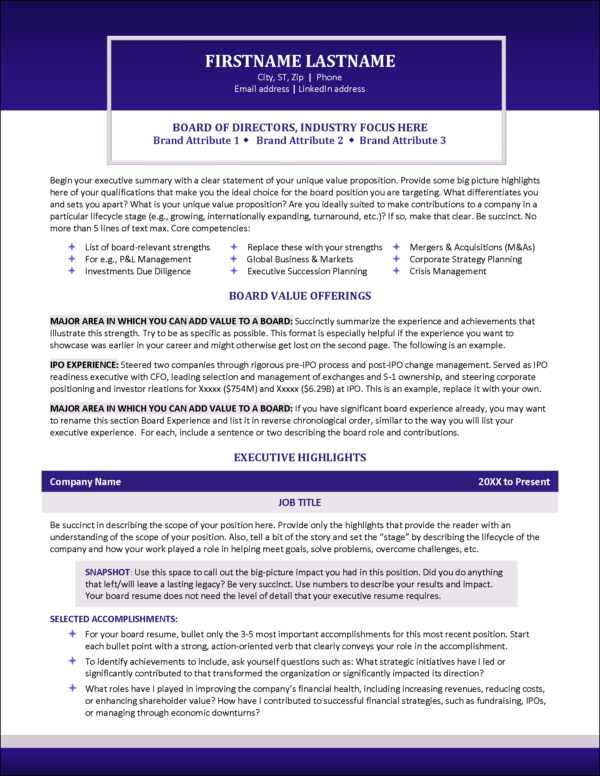
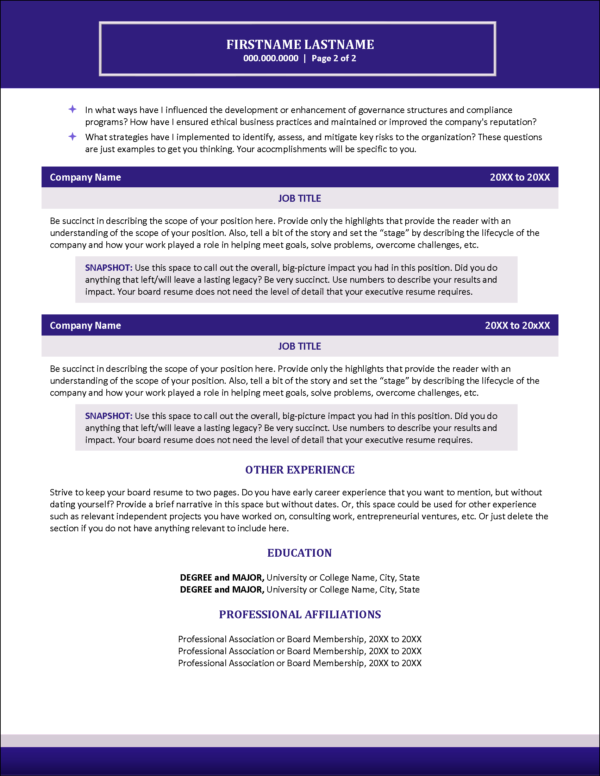
A board resume is a formal, two-page document designed to present your qualifications for board service. It’s tailored to highlight governance experience, strategic oversight, risk management, and committee involvement.
Unlike executive resumes, which emphasize operational leadership, team size, and revenue growth, a board resume demonstrates how you think, advise, and guide—rather than how you execute.
From our Board Star template collection, the following example shows the structure and format for a modern board resume.
What is a Board Bio?
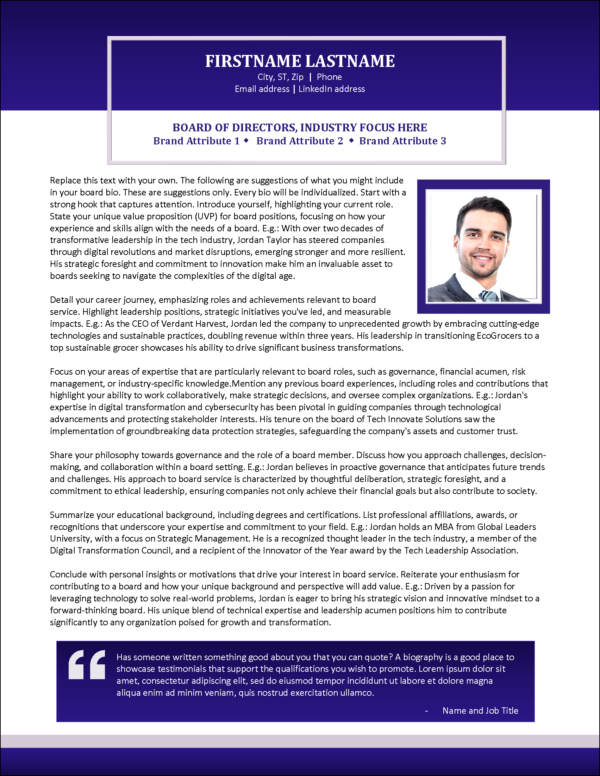
A board bio is a one-page, third-person narrative that presents your professional story in a concise, engaging, and brand-aligned way. It’s less about qualifications and more about positioning.
Think of it as your professional narrative for external audiences: it’s often used in board packets, speaker bios, introductions, or nomination submissions.
From the same Board Star collection, the following is an example format for a board bio.
Why You Need Both Documents for Your Board Portfolio
Now that the differences are clear, here’s why relying on just one document isn’t enough:
Use Cases: When to Use Your Board Resume vs Your Board Bio
Here are examples of when each document comes into play:
Board Resume Use Cases:
- Responding to board recruiter inquiries
- Submitting to nominating committees
- Applying for board roles via search firms
- Including in governance dossiers
Board Bio Use Cases:
- Speaker introductions or panel appearances
- Board announcements or public introductions
- Investor packets or stakeholder communications
- Executive summaries in nomination packets
In short: the board resume is about what qualifies you. The board bio is about how you want to be perceived.
How to Determine Which Board Document Is Expected
Requests for “a board resume” or “a board bio” are often made casually, and the person asking may not use the correct terminology. Here are a few tips to help determine what’s actually needed:
Being prepared with both document types in your board portfolio allows you to respond seamlessly and appear polished and proactive—without slowing down the process.
What Happens When You Use the Wrong One?
Will using a board bio instead of a board resume get your candidacy rejected outright? Probably not.
But it could dilute your message, create confusion, or leave the wrong impression—especially if your materials don’t match what the audience is expecting.
The more likely consequence? Missed opportunities and lost momentum.
For example:
In each of these cases, your qualifications aren’t the issue. The misstep lies in formatting your value in a way that doesn’t serve the moment.
Getting it right means your message lands cleanly—and the reader can immediately see your fit.
When you’re ready with the right document, you remove friction, reinforce credibility, and make it easier for people to advocate for you.
A Third Option: The Board Value Profile
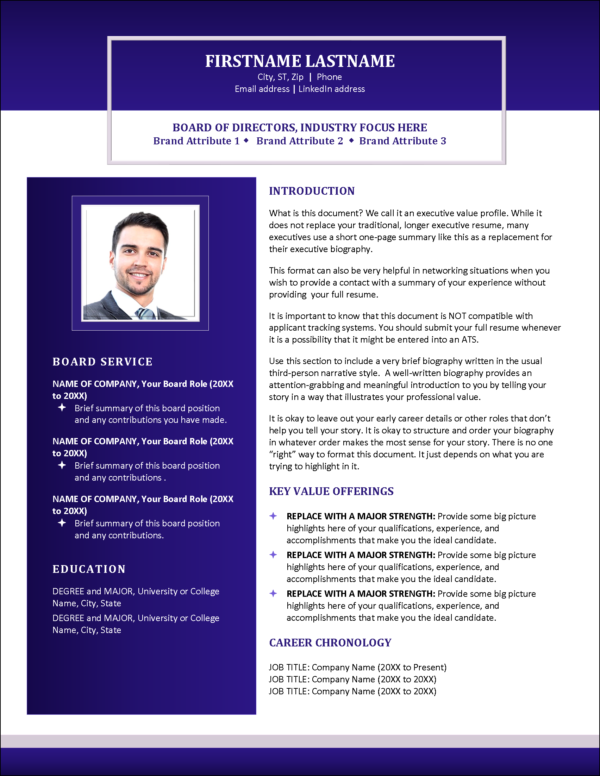
While a board resume and board bio are foundational, there’s also value in a third, hybrid solution: the Board Value Profile (aka Networking Resume).
This modern one-page document combines the clarity of a resume with the storytelling of a bio. It offers:
- A succinct, high-level view of your board readiness
- Governance-focused narrative paired with bullet-point highlights
- A format that works across formal and informal channels
When might you use it? The Board Value Profile is ideal when:
Because it lives between the formality of a resume and the narrative of a bio, a Board Value Profile bridges the gap across use cases—and can often spark further interest and conversation.
The following example, from the same Board Star Collection as the earlier examples, is a template for a Board Value Profile. While there is much flexibility in how you might structure these documents, this example shows one popular possibility.
What Your Board Portfolio Should Include
To be truly board-ready, consider preparing all three documents:
- Board Resume (2 pages): Structured, strategic, and aligned to board-level priorities
- Board Bio (1 page): Storytelling, brand-forward, public-facing
- Board Value Profile (1 page): Hybrid summary that covers all bases
Having all three allows you to:
- Respond quickly and appropriately to varied requests
- Align your messaging across different formats
- Reinforce your governance brand across multiple touchpoints
How to Create All Three Board Portfolio Documents with Confidence
You don’t need to be a professional resume writer—or spend weeks reinventing your documents—to build a polished, board-ready portfolio. You just need the right structure, guidance, and a strategic starting point.
Whether you’re creating your board portfolio documents from scratch or adapting existing materials, here’s how to approach each one:
Need Help Bringing Your Board Portfolio Together?
You don’t have to build your board documents from scratch—or second-guess what works.
We offer flexible, easy-to-use resources to help you craft all three documents with clarity and confidence:
- Board Resume Writing Toolkit – Our most comprehensive resource, with expert guidance and templates for your Board Resume, Board Bio, and Board Value Profile—all in one complete bundle.
- Individual Board of Director Resume Templates – Prefer to start with just one document? Choose your favorite template and be board ready in just one hour.
- Step-by-step instructions and real-world examples – So you’re never staring at a blank page.
Whether you’re aiming for your first board seat or expanding your presence in the boardroom, we’ll help you show up strategically—with professional, polished materials that reflect your governance value.
FAQs About Board Resumes and Bios
What is the difference between a board resume and a board bio?
A board resume is a two-page, formal document focused on governance qualifications, risk oversight, and fiduciary responsibilities. A board bio is a one-page, third-person narrative that tells your professional story in a more personal, public-facing way. Both are essential for board candidates.
Do I need both a board resume and a board bio?
Yes. Board resumes and board bios serve different purposes and are used in different contexts. Having both ensures you're prepared for requests from recruiters, nominating committees, and board introductions. Each document presents your qualifications from a different angle.
When should I use a board resume instead of a board bio?
Unless specifically asked for your board bio, use a board resume when submitting to board recruiters, search firms, or nominating committees. It’s the preferred format for formal board candidacy, showcasing qualifications like governance experience, committee roles, and strategic oversight.
When is a board bio more appropriate than a board resume?
A board bio is more appropriate for introductions, nominations, board packets, or networking situations where a narrative overview is needed. It’s especially useful when someone else is presenting or advocating on your behalf.
What is a board value profile?
A board value profile is a one-page hybrid document that combines elements of both a resume and a bio. It pairs strategic narrative with key qualifications and is ideal for peer-to-peer board introductions, networking, or providing a concise overview before formal due diligence.
Can I use my executive resume as a board resume?
Not effectively. Executive resumes focus on operational leadership and performance metrics. Board resumes require a shift toward governance readiness, strategic thinking, risk oversight, and stakeholder alignment. Repurposing without adaptation may hurt your candidacy.
How can I create a board resume, board bio, and board value profile?
While working with a skilled executive resume writing service such as that offered by Distinctive Career Services is ideal, if you prefer to DIY It, you can use professional templates and writing guides—like those in the Board Resume Writing Toolkit—to streamline the process. These resources help you create clear, board-appropriate documents that highlight your governance value and board readiness.
About the Author: Michelle Dumas