Artificial intelligence is changing the job market fast—and not always gently.
For mid-career professionals, the anxiety is real. Roles are being redefined, responsibilities are shifting, and tasks that once justified entire positions are now handled in seconds by machines. Advice tends to fall into two unhelpful extremes: “Don’t worry—your job is safe” or “Learn AI skills immediately or be left behind.”
Neither tells the full story.
The real risk isn’t AI itself. It’s being strategically mispositioned as AI reshapes how work gets done.
The professionals most vulnerable right now aren’t the least capable or least experienced. They’re the ones whose value is tightly tied to tasks AI can replicate—rather than to judgment, insight, leadership, or decision-making.
And here’s the part many people miss: A successful career pivot doesn’t begin with a job search. It begins with positioning. Without the right resume structure to communicate your evolving value, even a smart pivot can look unfocused—or risky—on paper.
This article introduces a smarter way forward.
Instead of running from AI, you can reposition yourself alongside it—by deliberately shifting toward work where your human strengths become more valuable, not less.
That’s the purpose of the V.A.L.U.E. Career Pivot Method.
Why “AI-Proof Careers” Is the Wrong Question—and What to Ask Instead
Search for advice on surviving AI, and you’ll find endless lists of “safe careers.” But this approach misses something critical: No career is permanently AI-proof.
Job titles evolve. Responsibilities change. Even historically “safe” roles are being reshaped by automation, analytics, and generative tools.
What is more durable is a career built around:
- Judgment over execution
- Insight over output
- Influence over process
- Decision-making over task completion
AI doesn’t replace expertise—it replaces unleveraged expertise.
So instead of asking, “What job should I switch to?” a better question is:
“How do I reposition my existing value so it remains relevant as AI changes the work?”
That’s where a structured pivot framework matters.
Introducing the V.A.L.U.E. Pivot Method: A Career Change Framework
The V.A.L.U.E. Career Pivot Method is a strategic framework designed for mid-career professionals who want to pivot intelligently—without starting over.
It helps you evaluate where your current role is vulnerable, identify which strengths still matter, and reposition yourself into work that benefits from AI rather than competing with it.
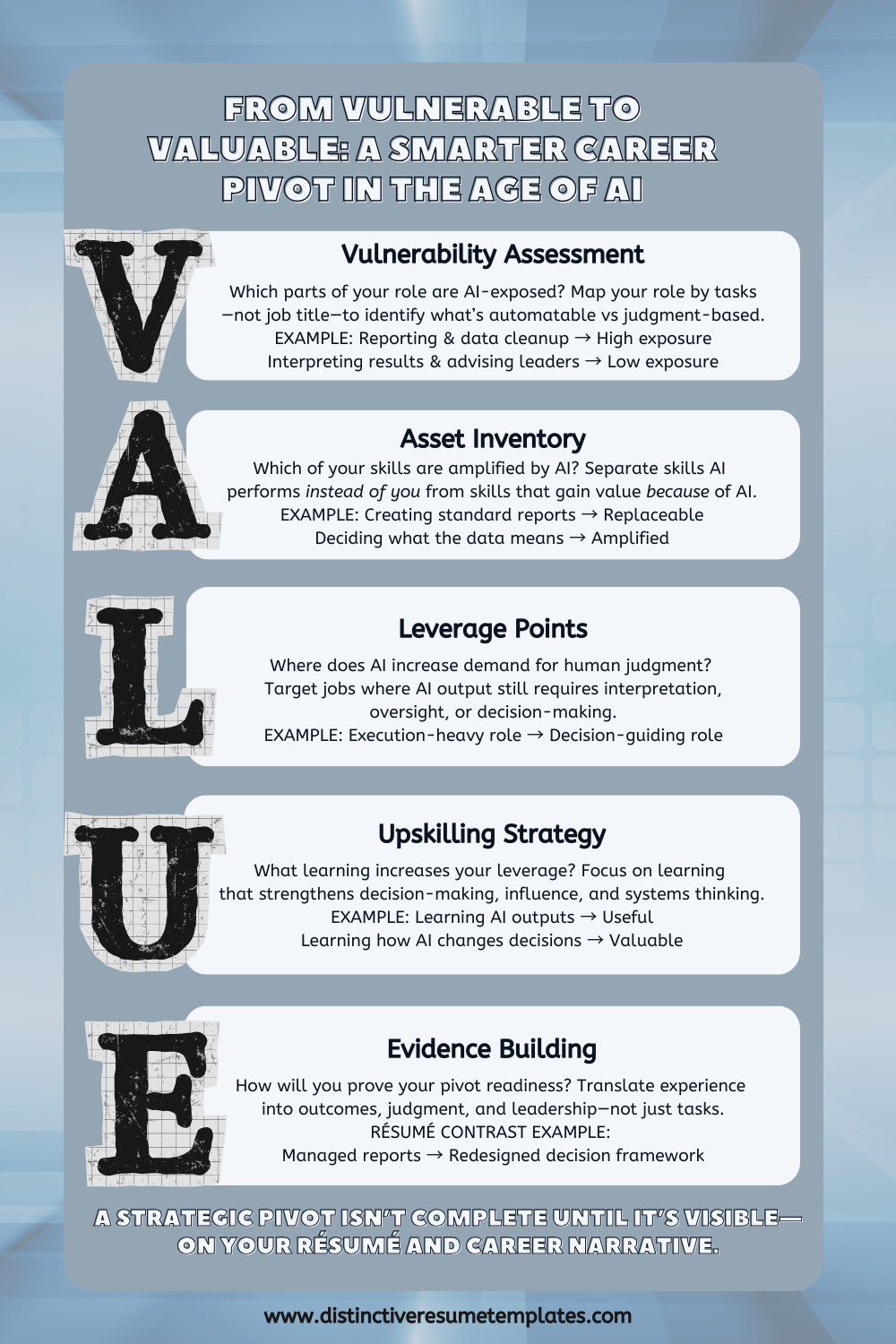
The framework includes five steps:
- 1V – Vulnerability Assessment
- 2A – Asset Inventory
- 3L – Leverage Points
- 4U – Upskilling Strategy
- 5E – Evidence Building
Let’s walk through each one.
V – Vulnerability Assessment: Understand Your Real AI Exposure
AI doesn’t eliminate jobs. It reshapes tasks.
That distinction matters.
Many professionals panic when they see their job title mentioned in an AI article. But within any role, some responsibilities are highly automatable—and others are not.
A smarter starting point is to map your current role across task categories such as:
- Repetitive execution
- Data processing
- Pattern recognition
- Judgment and decision-making
- Stakeholder communication
- Strategic planning
- Risk assessment
If a large portion of your role is rule-based, repeatable, or transactional, it’s more exposed. If your value lies in interpreting information, guiding decisions, managing complexity, or influencing outcomes, AI is more likely to augment your work rather than replace it.
Example:
A financial analyst spends 60% of their time pulling reports, cleaning data, and creating standard visualizations—tasks now largely automated by AI tools. But they also interpret anomalies, advise leaders on timing and trade-offs, and communicate risk to non-financial stakeholders.
The first set of tasks is vulnerable. The second set is where their real value lives—and where they should be repositioning.
This step replaces vague fear with clarity and highlights which parts of your role are worth strengthening and showcasing.
A – Asset Inventory: Separate Replaceable Skills From AI Amplified Ones
Many professionals struggle during a career pivot because they treat all skills as equal.
They aren’t.
The Asset Inventory step forces you to distinguish between skills AI performs instead of you and skills AI makes you better at.
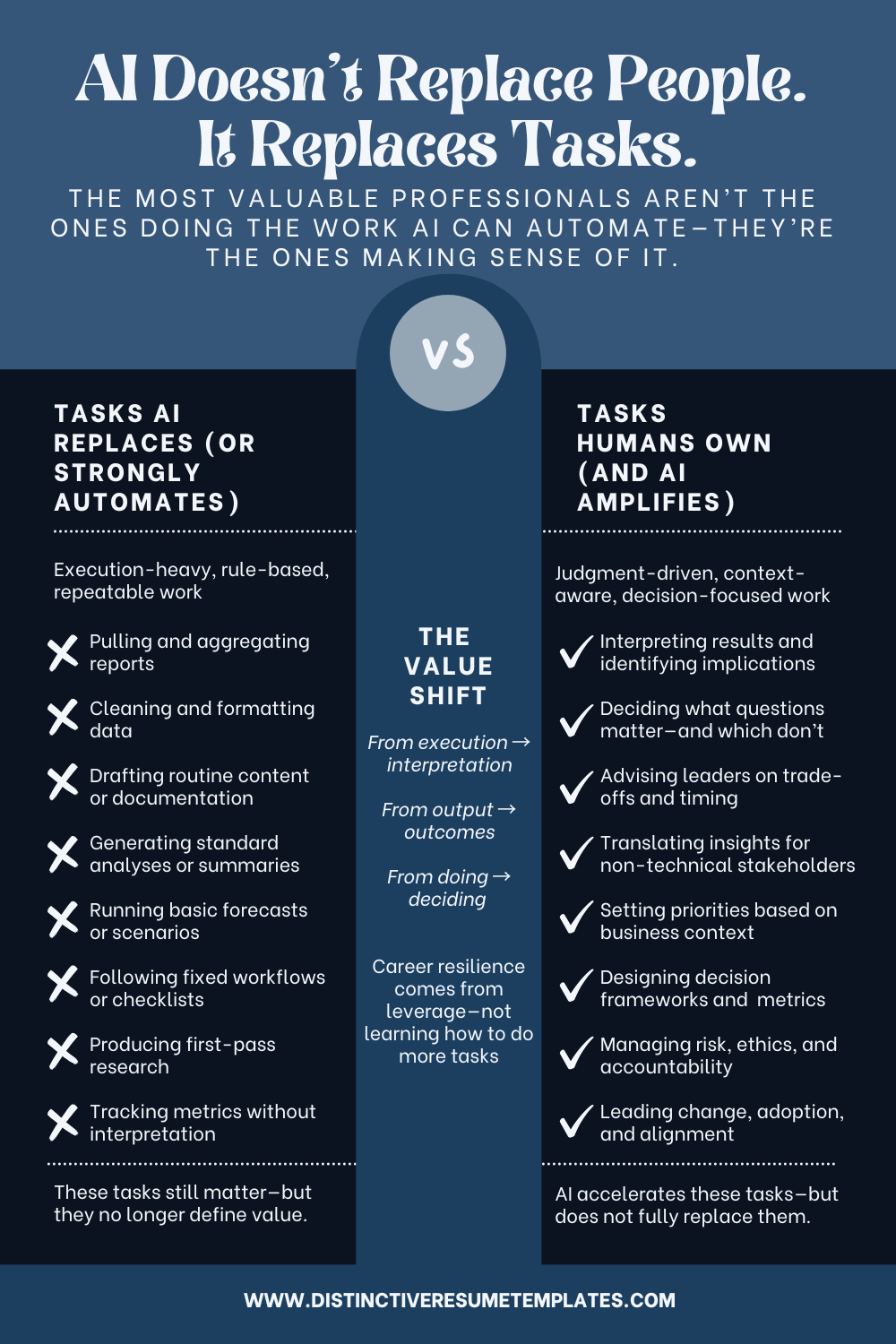
Skills AI often replaces:
- Manual reporting
- Basic research synthesis
- Routine documentation
- Standardized analysis
Skills AI typically amplifies:
- Strategic thinking
- Pattern interpretation
- Scenario planning
- Cross-functional communication
- Decision-making under uncertainty
- Ethical judgment and accountability
This is where many mid-career professionals underestimate their value. Their expertise isn’t obsolete—it’s simply buried under execution-heavy work.
The goal isn’t to discard your background. It’s to reposition it around higher-leverage contributions.
L – Leverage Points: Pivot Toward Roles That Gain Value From AI
This is where the pivot becomes strategic.
Leverage Points are roles or functions where AI increases the need for human oversight, interpretation, and leadership.
These roles often:
- Translate technical outputs into business decisions
- Oversee AI-driven processes rather than execute them
- Integrate insights across teams, systems, or stakeholders
- Manage risk, compliance, ethics, or governance
- Guide strategy, prioritization, and change
Importantly, these pivots don’t require abandoning your industry or starting over. They usually sit adjacent to your current role—but operate at a higher altitude.
Instead of being the person who produces the output, you become the person who:
- Decides what matters
- Interprets results
- Guides action
- Owns outcomes
That shift—from execution to leverage—is what moves you from vulnerable to valuable.
Example:
A marketing manager who once spent weeks building campaign reports can pivot toward a marketing operations or strategy role—designing measurement frameworks, governing AI-generated content, and aligning campaigns with business priorities.
The title may change slightly, but the expertise is the same. The altitude is higher.
U – Upskilling Strategy: Complement AI—Don’t Compete With It
“Learn AI” is common advice—and often incomplete.
You don’t need to become a technologist to stay relevant. You need targeted learning that increases your leverage rather than making you interchangeable.
Effective upskilling tends to focus on:
- Domain-specific AI applications
- Decision-making frameworks
- Advanced communication and influence
- Systems thinking
- Change leadership
- Risk, ethics, and governance
Example:
A project manager doesn’t need to learn how to build AI models—but learning how AI-generated forecasts affect resource planning, risk assessment, and stakeholder communication makes them more valuable, not more technical.
If your upskilling path turns you into a junior version of a machine, it’s not a strategy—it’s a misstep.
The goal is to become harder to replace, not easier to compare.
E – Evidence Building: Turn Strategy Into Proof
This is where many career pivots stall.
Not because professionals lack experience—but because they struggle to demonstrate career pivot readiness in a way employers immediately understand.
Hiring managers don’t hire intentions. They hire evidence.
Evidence Building means:
- Reframing experience to emphasize judgment, leadership, and outcomes
- Highlighting transferable achievements that support your next role
- Demonstrating progression toward higher-leverage responsibilities
- Aligning your resume and LinkedIn profile with your pivot direction
This is also where traditional resume formats often fall short.
Career-change and career-advancement pivots require a structure that elevates transferable value—not just chronological history. Without that structure, even a well-planned pivot can look scattered or risky.
This is exactly the gap Distinctive Resume Templates are designed to solve. Rather than forcing a linear career story, these templates help you:
- Reframe experience around themes, strengths, and impact
- Surface transferable achievements without minimizing past roles
- Control the narrative of your pivot instead of leaving it to interpretation
How the V.A.L.U.E. Pivot Method Shows Up on Your Resume
A strategic pivot doesn’t require reinventing your background—it requires reframing it.
When executed well, the V.A.L.U.E. Career Pivot Method shows up on your resume in visible, intentional ways:
- A resume summary that emphasizes value creation, not job titles
- Skills grouped by strategic themes rather than task lists
- Experience written to highlight decision-making, leadership, and outcomes
- Clear signals that your career trajectory is intentional—not reactive
Example:
Instead of listing “Managed reporting process for sales team,” a repositioned resume might say:
“Redesigned performance measurement framework, reducing reporting cycle time by 40% while increasing leadership adoption of data-driven decision-making.”
Same experience. Different framing.
The first describes a task AI now handles. The second emphasizes judgment, systems thinking, and influence—exactly what hiring managers need in an AI-augmented environment.
Turning the V.A.L.U.E. Pivot Method Into Action
AI isn’t the end of mid-career relevance—but it is the end of passive career management.
The professionals who thrive in the next phase of work won’t be the ones who chase every new tool. They’ll be the ones who intentionally reposition their expertise—and communicate that value clearly.
The V.A.L.U.E. Career Pivot Method gives you the framework.
Execution is the next step.
And that execution starts with the right tools.
If you’re navigating a career shift or repositioning for advancement, explore:
- The Career Change Resume Writing Toolkit
- The Career Advancement Resume Writing Toolkit
- The Pivot Point Bundle (for professionals making a strategic pivot)
- The Flexible Foundations Bundle (for adaptable, future-ready positioning)
Each is designed to help you translate insight into evidence—and position your experience for where you’re going next, not just where you’ve been.
About the Author: Michelle Dumas